A cleaning contract that looks solid on page one can unravel by month three. Vague service descriptions, buried auto-renewals, surprise fees for basic supplies these problems cost Kansas City facility managers thousands of dollars and months of frustration every year.
Q1 is when most of these agreements come up for review. Budgets are finalized. Vendor performance from winter the toughest season for any building is fresh and measurable. If you are evaluating your commercial cleaning contract Kansas City provider handed you, this is the moment to look closely at what you actually signed.
This guide covers seven contract red flags, what a strong agreement looks like, and the exact questions to ask before committing to any provider.
Why Your Contract Matters More Than the Bid Price
The lowest bid wins a lot of cleaning contracts. It also creates a lot of regret. A low price means nothing if the contract allows the provider to skip tasks, charge surprise fees, or lock you into a multi-year term with no exit.
A strong commercial cleaning contract Kansas City facility managers depend on does three things: it spells out the scope of work in specific detail, it locks pricing with transparent terms, and it builds in accountability for both sides. If your current agreement misses any of these, renewal season is your chance to fix it.
What a Bad Contract Actually Costs
The damage goes well beyond the monthly invoice:
- Tenant complaints multiply. Inconsistent cleaning erodes tenant trust and creates repeat calls that eat your team’s time.
- Sick days climb. Neglected restrooms and untouched high-touch surfaces spread illness through the building.
- Liability exposure grows. No floor care schedule or wet weather protocol? One slip-and-fall claim can cost more than a year of cleaning.
- Hidden charges stack up. Vague pricing language lets providers bill extra for supplies, equipment, and tasks you assumed were included.
- You get trapped. Auto-renewal clauses and 90-day notice windows keep you locked in long after performance drops.
Ahlers Building Maintenance hears these stories every Q1. Facility managers call after months stuck in contracts that looked fine on paper but failed in practice. This guide helps you spot these problems before you sign. See what quality service looks like on our commercial janitorial services page.

7 Red Flags in Commercial Cleaning Contracts
Not every bad contract is obvious. Some red flags hide behind professional-looking language. Here are seven that Kansas City facility managers catch too late.
1. Vague Scope of Work
This is the single biggest source of contract disputes. If the scope says “general cleaning of common areas” or “restroom maintenance as needed,” you have a problem. Those phrases mean whatever the provider decides they mean.
A scope worth signing lists every area (lobby, restrooms, break rooms, offices, hallways, elevators, stairwells), every task per area (vacuum, mop, disinfect sinks, empty bins, clean mirrors), every frequency (nightly, weekly, monthly, quarterly), and clear exclusions for what is NOT included. If the scope fits on half a page, it is not detailed enough. A mid-size Kansas City office building needs two to four pages of specifics.
2. No Quality Control Process
A contract without a quality control process is a contract without teeth. You need scheduled inspections (weekly or monthly walk-throughs), a named supervisor on your account, a documented complaint process with response time commitments, and written task-completion logs. Without these, you have no structured way to enforce the scope and the provider knows it.
Ahlers Building Maintenance assigns a dedicated account manager to every client and runs regular site inspections. Problems get caught before they become complaints. Learn more on our about us page.
3. Hidden Fees and Unclear Pricing
The number on page one rarely tells the full story. Watch for these:
- Supply charges paper towels, soap, liners, and toilet paper billed on top of the base price
- Equipment fees charges for vacuums, scrubbers, or specialized tools
- Holiday/overtime rates higher pricing for cleaning on holidays or outside standard hours
- Automatic escalation clauses 3–5% annual increases baked in without negotiation
- Emergency surcharges extra fees for spills, floods, or unexpected messes
Before signing any commercial cleaning contract Kansas City providers hand you, ask one question directly: “What is NOT included in this price?” A trustworthy company answers that in writing.
4. Auto-Renewal Traps
Auto-renewal clauses are standard. The trap is when they pair with 60–90 day notice windows buried in fine print. Miss the cancellation deadline by one day and you are locked in for another full year.
Protect yourself: negotiate a 30-day notice period, request month-to-month terms after the initial year, set a calendar reminder 120 days before renewal, and ask the provider to send a written reminder before auto-renewal triggers.
5. No Employee Screening Standards
Cleaning crews enter your building after hours with access to offices, server rooms, and sensitive documents. The contract should specify background checks, drug screening, training protocols for chemical and equipment handling, ID requirements (uniforms or badges), and a notification process when staff changes occur on your account.
Ahlers Building Maintenance screens and trains every employee. The people inside your building reflect on your business and ours. See what clients say on our testimonials page.
6. Missing Insurance and Bonding
Every cleaning provider should carry general liability ($1M minimum per occurrence), workers’ compensation for all staff on your property, and a janitorial surety bond protecting against theft or damage. Your building should be listed as an additional insured.
Request current Certificates of Insurance (COIs) before signing. A reputable provider delivers these within 48 hours. Hesitation or excuses? That alone is reason to walk away.
7. No Performance Guarantees or Exit Clauses
If the provider consistently underperforms and the contract has no remedy, you pay for bad service until the term expires. Strong contracts include a performance guarantee tied to specific standards (“all restrooms cleaned and restocked nightly” not “restrooms maintained”), a cure period (14–30 days to fix documented issues), a termination-for-cause clause, and a termination-for-convenience clause with 30–60 days’ notice.
A company that refuses performance guarantees may not trust its own service quality. That tells you everything you need to know.
What a Strong Cleaning Contract Looks Like
Use this as your benchmark when reviewing any commercial cleaning contract in Kansas City vendors present.
Scope and Pricing
Every building area gets a task list with frequencies. Seasonal work carpet deep cleaning, floor stripping, window washing appears with separate pricing and schedules. The monthly fee states exactly what it covers, exactly what it does not, and the cost for every add-on. Annual increases are capped and require 60 days’ written notice. Visit our floor cleaning services page for examples of periodic maintenance.
Communication and Accountability
The contract names a primary contact with a direct phone number, defines a complaint process with response time commitments (e.g., “within 2 hours during business hours”), schedules monthly or quarterly account reviews, and requires written reports documenting completed work and inspection results.
Insurance and Compliance
The provider maintains current insurance and bonding for the full contract term and notifies you immediately if coverage lapses. For Kansas City properties, look for OSHA training documentation, chemical Safety Data Sheets (SDS), and Green Seal certification if your building follows sustainable practices.
How to Compare Cleaning Bids in Kansas City
Compare Scope First
Line up each bid’s scope side by side. A bid that saves $500/month may exclude restroom supplies, floor waxing, or window cleaning that other bids cover. Build a simple spreadsheet: Area, Task, Frequency. Fill it in for each proposal. The gaps show themselves immediately.
Ask the Questions That Matter
These five questions separate strong providers from weak ones:
- “Who specifically will clean my building?” Own employees or subcontractors? Subcontracted crews mean higher turnover and less control.
- “What happens when my crew calls in sick?” Professional companies have backup plans. Unprepared ones skip the night.
- “Can I speak with three clients who have buildings like mine?” Relevant references beat generic testimonials.
- “What is your turnover rate?” High turnover means a different crew every few weeks and inconsistent results.
- “How exactly do you handle complaints?” You want a process, not a promise.
Why Q1 2026 Is the Right Time to Act
Most Kansas City commercial properties run calendar-year budgets. January sets the plan. February and March are when managers evaluate vendors and collect bids. If your contract renews in Q2 or Q3, this is the window to negotiate or switch while you still have time and options.
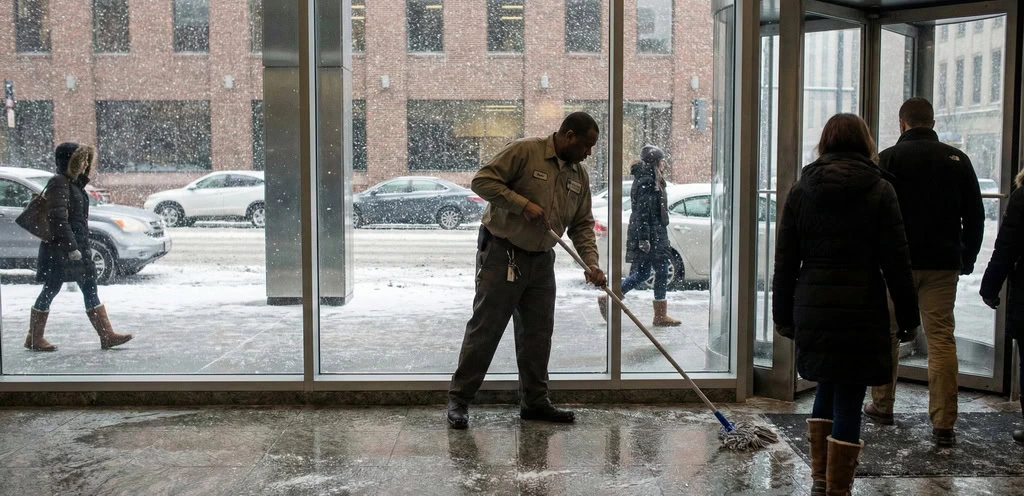
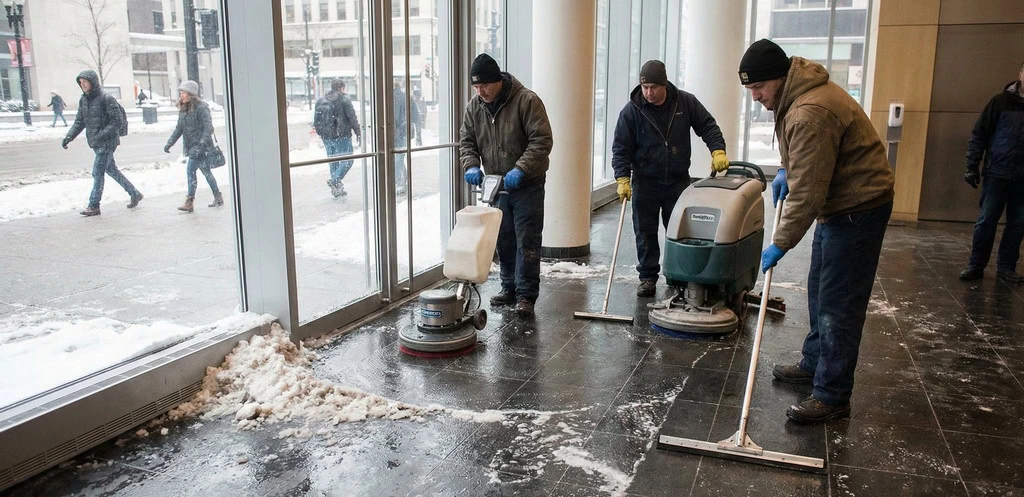
Winter also gives you the clearest performance data. Wet floors, salt tracking, restroom traffic, entry mat maintenance these pressure-test any cleaning provider. If your current company struggled through December and January, that pattern will not reverse in the spring. Trust what you saw. Learn more in our guide on protecting your business floors.
Pre-Signing Checklist
Answer every question below with “yes” before you commit. If you cannot, request revisions.
- Does the scope list every area, task, and frequency in specific detail?
- Does the pricing section state what is included AND what costs extra?
- Is the initial term 12 months or less?
- Can you cancel with 30 days’ notice for documented performance failures?
- Has the provider supplied current COIs for liability, workers’ comp, and bonding?
- Does the contract name a quality control process with scheduled inspections?
- Are employee screening and training standards in writing?
- Is there a complaint resolution process with defined response times?
- Are auto-renewal terms reasonable with an easy opt-out?
- Have you spoken with at least three current client references?
A provider that pushes back on any of these items is showing you how they handle accountability. Believe them.
FAQs About Commercial Cleaning Contracts
What should a commercial cleaning contract include?
A detailed scope of work with area-by-area task lists and frequencies, transparent pricing with all costs itemized, insurance and bonding requirements, employee screening standards, a quality control process, contract term and renewal conditions, termination clauses, and a communication plan.
How much do commercial cleaning services cost in Kansas City?
Small offices (under 5,000 sq ft) with nightly cleaning typically run $500–$1,200/month. Mid-size buildings (10,000–50,000 sq ft) range from $1,500–$5,000/month. Ahlers Building Maintenance provides free site walk-throughs and detailed bids for any Kansas City commercial property.
Should I choose the cheapest bid?
Rarely. The cheapest bid usually means a smaller scope, lower-quality products, or subcontracted labor. A provider that costs 15% more but includes supplies, inspections, and a performance guarantee will save you money over 12 months.
How long should a first contract last?
Twelve months is standard for a new provider. After that, negotiate month-to-month terms. Avoid agreements longer than 24 months unless the relationship is well-tested. Always include a termination-for-cause clause.
What is a janitorial bond?
A surety bond that protects your property against theft or damage by cleaning staff. It is separate from general liability insurance. Any provider with after-hours building access should carry one.
Can I switch providers mid-contract?
If your contract has a termination-for-cause clause, yes after documenting failures and allowing the cure period. Without that clause, you may wait until the term ends. This is why reviewing exit terms before signing matters.
How do I know my current provider is underperforming?
Watch for repeated tenant complaints, restroom supplies running out regularly, visible dust or grime in common areas, inconsistent floors, slow response to requests, and high crew turnover. Three or more of these patterns signal it is time to evaluate alternatives.
Get a Contract You Can Trust
Ahlers Building Maintenance has served Kansas City businesses for over 20 years. We provide clear contracts, transparent pricing, named account managers, scheduled inspections, and performance guarantees. We do not use subcontractors. Every employee is screened, trained, and accountable.
If your commercial cleaning contract in Kansas City agreement is up for renewal or you are ready for a provider that puts quality in writing contact us for a free, no-obligation bid.
Call 913-894-4440 or visit our contact page to schedule a building assessment.